Wednesday, September 10, 2014
The Big Cheese Dog
He called himself "The Big Cheese Dog". The purpose of this reference was to insure to his students, his audience, that what he was about to state was to be written down, that this nugget of information was somehow to be seared into the recesses of their minds. His classes were, generally speaking, attentive, whether they were seventh graders or seniors or somewhere in between. The words, "The Big Cheese Dog", were simply the icing on the cake. Prior to the conclusion that included those words were a series of gestures, gyrations, stories, analogies, graphs, demonstrations, and other illustrations that kept attention and attempted to make the complex real. As a former math student of Paul Edward's stated, "I'll never forget the chalk all over Mr. Edwards' pants as he would rise up and down on his tippy toes, flailing his arms and scribbling on the board as he lectured". I remember when he took his math class outside for "a wake up call". The students were drowsy and didn't meet Paul's expectation of attentiveness so his class took a brief field trip into the Minnesota winter, a crisp -10°F awakening that attributed to the legend of his intensity and his commitment to the education of his students.
Paul passed away August 6th, 2014. With his passing, a hole opened in my soul. I taught with Paul in two school districts. We commuted for 7 years to one of those districts. We had an hour and a half each day to share ourselves. I loved and admired Paul. He showed me that math could be cool. He made me aware that I was not alone, there were others that were as passionate about mathematics I was. He being one. During our commutes we would be irrelevant, challenging, blasphemous, contemplative, and flippant. Our mantra was that "only fools took themselves seriously." We really believed that the two of us could change the world, as Paul often quoted, "Chuck, its us against the world of ignorance." We once convinced a colleague that Ozzy Osbourne was the son of Bob Keeshan, Captain Kangaroo.
Practical jokes were not limited to "outsiders". I convinced students that Paul's real name was Polycarp Whitecloud Edwards and registered him as such for a national mathematics convention. As he picked his name card and realized what was printed on it, a series of expletives were machine gunned at me. The resulting expense of calming beers was worth his reaction. In turn, he frequently enjoyed placing my car keys in strategic locations in my room prior to the end of our work day. The most memorable being just 18 inches above my head resting on my document camera. The calming beers on that Friday were well received.
Paul and I worked on our masters degrees together. Our degrees are in mathematics. Paul started ahead of me. He saw the potential of a masters degree in mathematics. He eventually left teaching and applied what he learned in the area of Statistics. Our relationship became more focused on the success of learning a higher level of mathematics. Our individual strengths complemented each other. Paul was excellent at taking notes. I, in contrast, listened. We would share our perspectives, mine, a view of the "big picture" and his, a detailed account on how to get from point A to point B. His wife quipped that she overheard our discussions and believed we were making up the words, "real people didn't really talk that way."
Paul's life and mine coincided for 13 years, merging at one district and diverging at another. He changed the way I teach and eventually how I view my own life. He could be intense and childlike within the same moment. I will miss him. He told me that he loved me as a brother. I will always cherish his love.
Tuesday, June 3, 2014
2014 Calculus Presentations
Today is the birthday of Karl Gruenberg born 1928 in Vienna, Austria. Gruenberg worked in finite group theory.
Today's quote is from Kareem Abdul-Jabbar who said, "Music rhythms are mathematical patterns. When you hear a song and your body starts moving with it, your body is doing math. The kids in their parents' garage practicing to be a band, may not realize it but they are also practicing math."
For my AP Calculus Final, I assign the students to find a topic they love to do or have a strong interest in exploring. I am trying to convey the idea that mathematics exists in everything. All a person has to do is look for the mathematics. The students form groups and give their presentations on their agreed upon topic. These presentations are linked to their Youtube videos. Not all the topics have links due to video production scheduling. At the end of this blog, I also have links to the powerpoint presentations. The following are the opics various groups of students presented: Airplanes, Bowling, Cats, Counter-Strike, Disney, DQ Ice Cream, Golf, Hurdling, Income Gaps, Juggling, Math on the Beach, Pickleball, Ping Pong, Quadcopter, Searching for Sasquatch, Stellar High 5, and Volleyball.
The power points for the following topics are also linked at: Calculus Presentations.
Today's quote is from Kareem Abdul-Jabbar who said, "Music rhythms are mathematical patterns. When you hear a song and your body starts moving with it, your body is doing math. The kids in their parents' garage practicing to be a band, may not realize it but they are also practicing math."
For my AP Calculus Final, I assign the students to find a topic they love to do or have a strong interest in exploring. I am trying to convey the idea that mathematics exists in everything. All a person has to do is look for the mathematics. The students form groups and give their presentations on their agreed upon topic. These presentations are linked to their Youtube videos. Not all the topics have links due to video production scheduling. At the end of this blog, I also have links to the powerpoint presentations. The following are the opics various groups of students presented: Airplanes, Bowling, Cats, Counter-Strike, Disney, DQ Ice Cream, Golf, Hurdling, Income Gaps, Juggling, Math on the Beach, Pickleball, Ping Pong, Quadcopter, Searching for Sasquatch, Stellar High 5, and Volleyball.
The power points for the following topics are also linked at: Calculus Presentations.
Sunday, June 1, 2014
Taking a Risk
Today is the birthday of Edward Titchmarsh born 1899 in Newbury, Berkshire, England. Titchmarch work was in analysis. He studied Fourier Series and Fourier Integrals. Titchmarsh is the author of today's quote. He said, "It can be of no practical use to know that π is irrational, but if we can know, it surely would be intolerable not to know."
I constantly lecture to my students the importance of taking a risk with the understanding that failure is a consequence. I must confess I am not a risk taker. My wife and my sons are. If I had not fell in love with my wife, I could very well see my self living in northern Minnesota, in some remote cabin, teaching mathematics in a small community.
I did take a risk this past week. I spoke at our high school's graduation ceremony. Speaking in front of a large group of people has never been on my bucket list and now, I can say that it never will. I am sharing my speech both in written form and as a Youtube video. I do so because I feel that this blog is a diary of sorts. I will let you be the judge of the speech. I am not a public speaker. I am aware of my mistakes and flaws.
Robin Williams states, "We don't read and write poetry because it's cute. We read and write poetry because we are members of the human race. And the human race is filled with passion. And medicine, law, business, engineering, these are noble pursuits and necessary to sustain life. But poetry, beauty, romance, love these are what we stay alive for."
That you are here--that life exists, and identity;
That the powerful play goes on, and you will contribute a verse.
I constantly lecture to my students the importance of taking a risk with the understanding that failure is a consequence. I must confess I am not a risk taker. My wife and my sons are. If I had not fell in love with my wife, I could very well see my self living in northern Minnesota, in some remote cabin, teaching mathematics in a small community.
I did take a risk this past week. I spoke at our high school's graduation ceremony. Speaking in front of a large group of people has never been on my bucket list and now, I can say that it never will. I am sharing my speech both in written form and as a Youtube video. I do so because I feel that this blog is a diary of sorts. I will let you be the judge of the speech. I am not a public speaker. I am aware of my mistakes and flaws.
Speech 5/27/2014
"Dr. Bittman, Mr. Martens, School Board Members, Staff and
Faculty, Friends and Family of the graduates, and the Class of 2014. (Cell phone rings) Hello? Hi Mom. Thanks but the speech is not tomorrow night. When? Ah… tonight. Yes, oh right now… No, that’s ok. I think he’ll understand. Yes, Mr. Martens has a mother too. Thanks
again. Say hi to Dad. Yes, I love you,
too.
I suppose you guessed that was my mom. She loves me. She always has. Both my dad and
mom worked at creating an environment that prepared me for adulthood. Growing
up, I looked forward to adulthood and its freedoms; but adulthood has its
responsibilities.
When I was asked to speak at this graduation ceremony I
pondered a great deal what would be my theme. I know math; really not much else. I thought of graduation speeches I had heard. One speaker sang, while another danced. When I suggested these ideas to my
family. They reminded me that as a youth
I was told to mouth the words in choir and in college, I almost failed ballroom
dancing. I was dismayed. So I went for a walk with Rosie. Rosie is my dog and
is a great listener. When I told her of my dilemma, her response was to wag and
pant in her nonverbal dog way. I had to agree with Rosie. I would talk about
what I knew: math and poetry. You see, Rosie knows that prior to our morning
walk I work on a math problem and read a bit of poetry. Rosie is a pretty smart
dog.
Mathematics is a way to solve problems. In a recent
conservation with my dad, he conveyed to me his concern of the future
generations’ ability to solve problems. He believes as do I that upon
graduation we transition from celebration to responsibility. I assured him that
our graduates, you who are in front of me now have the tools to solve problems,
the problems within our relationships, the problems within our communities, our
society, our world. I would not be in front of you; the faculty, the school
board and the administration would not be in front of you; if we did not
believe that to be true. We have placed our stamp of approval that you are
ready for the next step; to help us solve problems, to be the stewards of our
communities.
I believe problems are solved with the continued acquisition
of knowledge, the ebb and flow of communication, hard work, and creativity.
You need to be life long learners; learning through
experience and through education spawned by curiosity. Albert Einstein said,
“Intellectual growth should commence at birth and cease only at death” and
Henry Ford quipped “Anyone who stops learning is old, whether at twenty or
eighty. Anyone who keeps learning stays
young.”
Knowledge is a powerful tool.
Being able to communicate is a two way street. You need to
be understood, to be able create a conversation that is reasonable and sound, a
conversation that is clear and easy to understand, and a conversation that is
open to a response. Communication requires the ability to listen. That ability
not only includes listening to those with whom you agree with but also listening
to those who offer an alternative opinion.
As with real math problems, the problems that surround us
will take time, hard work, perseverance, and focus but you have the tools and
have the ability to gather more tools to address the problems before us. I
suggest to my students that they work in groups. There is power within groups. When
groups work at solving problems, they develop cohesiveness. They become accustomed to each other’s
rhythm… each other’s poetic meter. You
have experienced these communities in our school whether you participated in any
of our co-curricular or extra-curricular activities. As these communities
solved problems , you became connected to your peers. You became part of the larger dynamical
community we call high school. Last week was the birthday of Edward Lorenz,
a-would be mathematician who decided instead to study meteorology. Lorenz initiated the idea of chaos
theory. Lorenz termed chaos theory as
“the butterfly effect” in his presentation, “Does the flap of a butterfly’s
wings in Brazil set off a tornado in Texas?” You are part of the “butterfly
effect”, your actions affect the dynamical system we call community.
A community has gathered around you tonight. They solved the
problem of your education. Did it take time? Yes, about 13 years. Did it take
hard work? Yes. Look around you, look at this community that is proud you, you
are worth their time and their efforts.
Be creative in your problem solving. Allow yourself to take a risk, to view the
problem from different vantage points. Being innovative and entrepreneurial
will mean you will come to dead ends and at times, fail but creative people are
resilient and strong.
I am aware that not everyone becomes problem solvers in the
same manner. You will create your own path or take paths less traveled but we
are all of the same fabric, the cast of the same play. I was struck this year
by an advertisement from Apple for the IPAD. The ad had Robin Williams reciting
a scene from the movie in “The Dead Poets Society” in which he plays John
Keating. In this scene he quotes one of
my favorite poets, Walt Whitman.
By your birth you became members of the human race, with
this graduation you have become part of its solution. You will determine how you will be part of
it.
I will finish with this poem by Walt Whitman
'O ME! O life!... of the questions of these recurring;
Of the endless trains of the faithless--of cities fill'd with the
foolish;
Of myself forever reproaching myself, (for who more foolish than I,
and who more faithless?)
Of eyes that vainly crave the light--of the objects mean--of the
struggle ever renew'd;
Of the poor results of all--of the plodding and sordid crowds I see
around me;
Of the empty and useless years of the rest--with the rest me
intertwined;
The question, O me! so sad, recurring--What good amid these, O me, O
life?
Answer.
Of the endless trains of the faithless--of cities fill'd with the
foolish;
Of myself forever reproaching myself, (for who more foolish than I,
and who more faithless?)
Of eyes that vainly crave the light--of the objects mean--of the
struggle ever renew'd;
Of the poor results of all--of the plodding and sordid crowds I see
around me;
Of the empty and useless years of the rest--with the rest me
intertwined;
The question, O me! so sad, recurring--What good amid these, O me, O
life?
Answer.
That you are here--that life exists, and identity;
That the powerful play goes on, and you will contribute a verse.
You will contribute a verse.
What will your verse be?'"
Friday, May 16, 2014
My Struggle With Velocity and Mom
Today is the birthday of Pafnuty Chebyshev born 1821 in Okatovo, Kaluga Region, Russia. Chebyshev investigated number theory, mechanics, and invented orthogonal polynomials.
Today's mathematician's quote is from G. Simmons who said "To isolate mathematics from the practical demands of the sciences is to invite the sterility of a cow shut away from the bulls."
The lives of my younger brother's are a study of contrast. My younger brothers are identical twins. Their births were two minutes apart. The oldest of the pair just recently became a grandfather while my "youngest" brother is teaching his 15 year old daughter how to drive. I was fortunate to have the majority of the driver's education instruction fall on the slender but resilient shoulders of my wife.
My real behind-the-wheel experience of learning how to drive fell on my mother. I have a number of experiences that I can recall during that time, many of them are not pleasant. During the 1970's seat belts were in cars but were not used by anyone in my family except for the time I slammed on the brakes in the middle of a busy intersection catapulting my mother's head to the windshield of our banana colored 1972 Ford LTD.
Today's mathematician's quote is from G. Simmons who said "To isolate mathematics from the practical demands of the sciences is to invite the sterility of a cow shut away from the bulls."
The lives of my younger brother's are a study of contrast. My younger brothers are identical twins. Their births were two minutes apart. The oldest of the pair just recently became a grandfather while my "youngest" brother is teaching his 15 year old daughter how to drive. I was fortunate to have the majority of the driver's education instruction fall on the slender but resilient shoulders of my wife.
My real behind-the-wheel experience of learning how to drive fell on my mother. I have a number of experiences that I can recall during that time, many of them are not pleasant. During the 1970's seat belts were in cars but were not used by anyone in my family except for the time I slammed on the brakes in the middle of a busy intersection catapulting my mother's head to the windshield of our banana colored 1972 Ford LTD.
This is the car that my brothers and I referred to as the "banana boat".
I am sixteen and have hair.
A constant discussion between my mother and myself was my obsession with speed and lack of the proper use of the "gas pedal". The following sketch represents my mother's lament about the use of the accelerator. She would often describe me as a "heavy foot" driver.
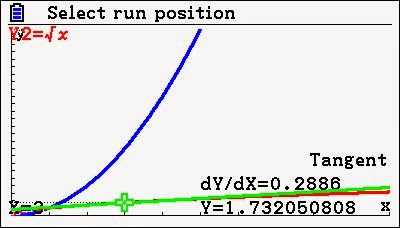
The graph that is labeled "Chuck" illustrates a quick gain of distance in a short period of time while the other graph labeled "Chuck's mom" indicates a gradual gain of distance in a greater time span. Both of these graphs are defined as position functions. They depict the distance traveled over an interval of time. The graphs are both increasing; one quickly, the other gradually both they differ in terms of mathematicians call concavity. The "Chuck" graph is concave up and my velocity is increasing. In calculus, velocity can be viewed as the slope of a line tangent to a position curve. I have examples below.
Notice for the same time value, x = 3, the slope of the green line on the upper graph is 0.2886 and the lower graph it is 6. When time increases as in the next two graphs, the slope decreases to 0.25 in the upper graph but increases to 16 in the lower graph.
In the upper graph, my velocity has decreased for another unit of time. I have negative acceleration. My mother is relaxed, viewing the dafodils blooming in the neighbor's garden, and sets aside the belt buckle she had placed in her lap. I turn down the volume on the radio as Perry Como sings "Mama Loves Mambo".
In the lower graph, my velocity has increased for another unit of time. I have positive acceleration. My mother has been forced further back into her seat, her eyes are closed, her teeth are clenched, and she is gripping tightly to the door handle. I, on the other hand, have the window open, and am looking for tanned coeds that are enthralled by the power in front of me.
When velocity and acceleration have the same signs (they are both positive or both negative), speed is increasing. When velocity and acceleration have opposite signs, speed is decreasing. Here is another example.
This is a graph of two velocity functions. Each graph is moving towards the x-axis. On the x-axis, each will have a value of zero so each velocity function is decreasing.
The slopes of the lines tangent to each of these graphs represents the acceleration of an object at a particular time, x.
These diagrams indicated that the acceleration is decreasing (-2 to -3),velocity is positive, and speed is decreasing.
The above diagrams show that acceleration is increasing, velocity is negative, and again speed is decreasing.
I have mellowed out in my quest for speed. I have become accustomed to letting the other drivers pass me by while I reflect on the mathematics I see around me. :-)
Sunday, May 4, 2014
Tractor, Slide Rule, Calculator, and The Digital World
Today is the birthday of Heinrich Jung born 1876 in Essen, Germany. Jung made contributions in the field of algebraic functions.
Today's quote is from Herbert Turnbull. He quipped, "The usefulness of mathematics in furthering the sciences is commonly acknowledged: but outside the ranks of the experts there is little enquiry into its nature and purpose as a deliberate human activity."
My dad and I were having a discussion about innovation. He grew up in South Dakota in the 1920's and 30's during the Dust Bowl. He remarked to me that he remembered the turmoil that a purchase of a tractor caused among neighboring farmers. I found an article that supported his perspective of that time. There are very few farmers that would subsist without the tractor.
Today's quote is from Herbert Turnbull. He quipped, "The usefulness of mathematics in furthering the sciences is commonly acknowledged: but outside the ranks of the experts there is little enquiry into its nature and purpose as a deliberate human activity."
My dad and I were having a discussion about innovation. He grew up in South Dakota in the 1920's and 30's during the Dust Bowl. He remarked to me that he remembered the turmoil that a purchase of a tractor caused among neighboring farmers. I found an article that supported his perspective of that time. There are very few farmers that would subsist without the tractor.
When I was in high school our choice of a calculating device was the slide rule. I still have my slide rule but am no longer proficient in using it. The logarithmic concepts on which it is based have stayed with me. The terms, mantissa and characteristic, have remained a common part of my vocabulary. :-) I did not use a calculator my high school mathematics classes even though the scientific calculator existed. I have colleagues that are approximately my age and they did use calculators in their high school math classes. I attributed my lack of technology to my mathematics teacher. He was an excellent teacher and was a strong influence in my career path, I don't believe he was of the nature to jump to the latest "trend" in teaching. He explained to me that he was confident that I would do well in college mathematics because the curriculum and instruction I received my K-12 experience built a solid foundation.
My parents purchased my first digital calculator as my high school graduation gift. The cost was $150 and it was a Hewlett Packard 35s. This calculator was in lieu of the traditional gift of suitcases.
I started collecting mechanic calculators a few years ago. The image below is a particular model I purchased at a flea market. A hardware/lumber yard store in my community has the same model on display. Their calculator was the original adding machine used when the company was first established.
My current calculator of choice is the Casio Prizm FX-CG10. This calculator has everything I want in a calculator. The graphics are in color and has a minimal number of keystrokes needed to accomplish specific tasks.
Our school to transitioning to 1 to 1. In mathematics, functions that are defined as 1 to 1 are those whose inverses are also functions. In the classroom, 1 to 1 means that each student is equipped with a digital device. As with any innovation, whether it is a tractor or a calculator there is a period of struggle to find its proper place. As with tractors, there were losses and gains as the calculator entered the mathematics classroom. Some mathematics concepts have fallen to the side while others have been advanced. I used to teach linear interpolation as a method to approximate nonlinear results. That topic is no longer applicable. I am able to give more meaning to the richness of functions in graphic and tabular ways. There are appropriate times to use the calculator in class but the use of the calculator exists and cannot be denied. I believe the same will be true in 1 to 1 classrooms. As educators, we will have our period of struggle, we will find appropriate times to use the devices in our classrooms but there is no denying that we are in a digital world and we must use all means available to us to engage our students.
Saturday, May 3, 2014
When I Grow Up I Want To Be A . . . LOBSTER FISHERMAN
Today is the birthday of Vito Voterra born 1860 in Ancona, Italy. Vito's work focused on partial differential equations with respect to the equation of cylindrical waves. His major work was on integral equations.
When I was in senior in high school I was still unsure what I wanted to be when I "grew up". My mother wanted me to be a pastor and I was considering a career as a member of the Coast Guard or a mathematics teacher. During my senior, we spent our Christmas visiting my sister in San Francisco. As we walked along the wharf, I had a moment of clarity. I proudly remarked,"I want to be a LOBSTER FISHERMAN". My mother erupted. She explained to me in no uncertain terms, my destiny. Her 60 inch frame grew as she became more agitated. I was subdued and have never spoke to her again about lobster fishing. I have visited the east coast many times and have watched the lobster boats come in to shore. The life is tough and precarious.
Every year I assign a final project to my calculus students. Their assignment is find the mathematics in what they love to do. I have had projects on music, tennis, dance, skating, Rubik's Cube, whiffle ball, Escher, and bowhunting carp to name a few. I, in turn, was wondering what mathematics existed in lobster fishing. I found a mathematics game called "Lobster Pots", a mathematical article examining the exploitation of the lobster fisheries, a website sponsored by Gulf of Maine Research Institute that details all aspects of lobsters which contains mathematical activities pertaining to the career of a lobster fisherman, and the use of mathematical modeling in the optimization of productivity of the fishing industry.
I often tell the story of my lobster fishing yearning to my students. A few years ago, Tyler, a student of mine, created this picture of me. In addition to my math class, he was taking a digital photography class. I am sure he was looking for lobsters but was resigned to use crabs from the show, "The Deadliest Catch". The students still enjoy this picture and it finds its way on social media occasionally. I particularly like the tattoos.
Friday, May 2, 2014
Happy Belated Birthday Rosie!
Today is the birthday of John Wilton born 1884 Belfast, Victoria, Australia. Wilton's work focused on Analysis and Number Theory.
Today's quote is by mathematician Salomon Bochner. He said, "The word 'mathematics' is a Greek word and, by origin, it means 'something that has been learned or understood,' or perhaps 'acquired knowledge,' or perhaps even, somewhat against grammar, 'acquirable knowledge,' that is, 'learnable knowledge,' that is, 'knowledge acquirable by learning."
Rosie is my dog. She is a 55 pound labrador and poodle cross often referred to as a "labradoodle". On March 8th she completed her eighth year. Her birthday celebration was brief. The weather outside was not conducive to a long walk nor did the squirrels who were invited to the backyard attend her birthday party due to the nastiness of this year's winter. According to the chart below, her age in "human years" is about 55 years.
Today's quote is by mathematician Salomon Bochner. He said, "The word 'mathematics' is a Greek word and, by origin, it means 'something that has been learned or understood,' or perhaps 'acquired knowledge,' or perhaps even, somewhat against grammar, 'acquirable knowledge,' that is, 'learnable knowledge,' that is, 'knowledge acquirable by learning."
Based on Rosie's age and weight, I used the orange graph and created the data plot below.
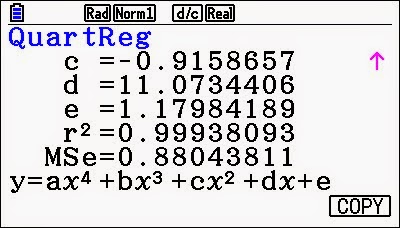
I used a graphing calculator's diagnostic capabilities to formulate an equation could be used to determine an human equivalent based on her age and weight.
The resulting formula is call a quartic function. This particular function is f(x) = -0.001258x^4 + 0.05795529x^3 - 0.9158657x^2 + 11.0734406x + 1.17984189. This function is just an estimate that is most accurate within the scatterplot. The further the age moves beyond 20 actual years, the more inaccurate the function becomes.
I chose this particular model based on the Mean Squared error (MSe) of the regression. This is a better indicator of fit that r^2 which is an analysis based on linear models.
Rosie is an awesome companion. She is always excited to see me. She is a great listener and has been a source of inspiration in developing scenarios of applied mathematics. This school year has been the year of Rosie. She has become somewhat of a cult hero. I hope her health stays well and she continues to inspire students in my classroom.
Subscribe to:
Posts (Atom)